ChatGPT for Translation: When It Works, When It Doesn't
Learn when ChatGPT is useful for translation, where it fails, how to prompt it, and when a complete-file translation tool is the safer workflow.
The Short Answer: ChatGPT Is a Language Assistant, Not a Universal File Translator
ChatGPT is useful for translating short text, exploring tone, applying a glossary, comparing alternatives, and reviewing difficult passages. It is less reliable when the job requires guaranteed completeness, stable processing across a long book, preserved PDF or DOCX structure, subtitle timing, or a finished downloadable file.
Use ChatGPT when the main problem is language judgment. Use a dedicated translation workflow when the main problem is processing and reconstructing a complete document.
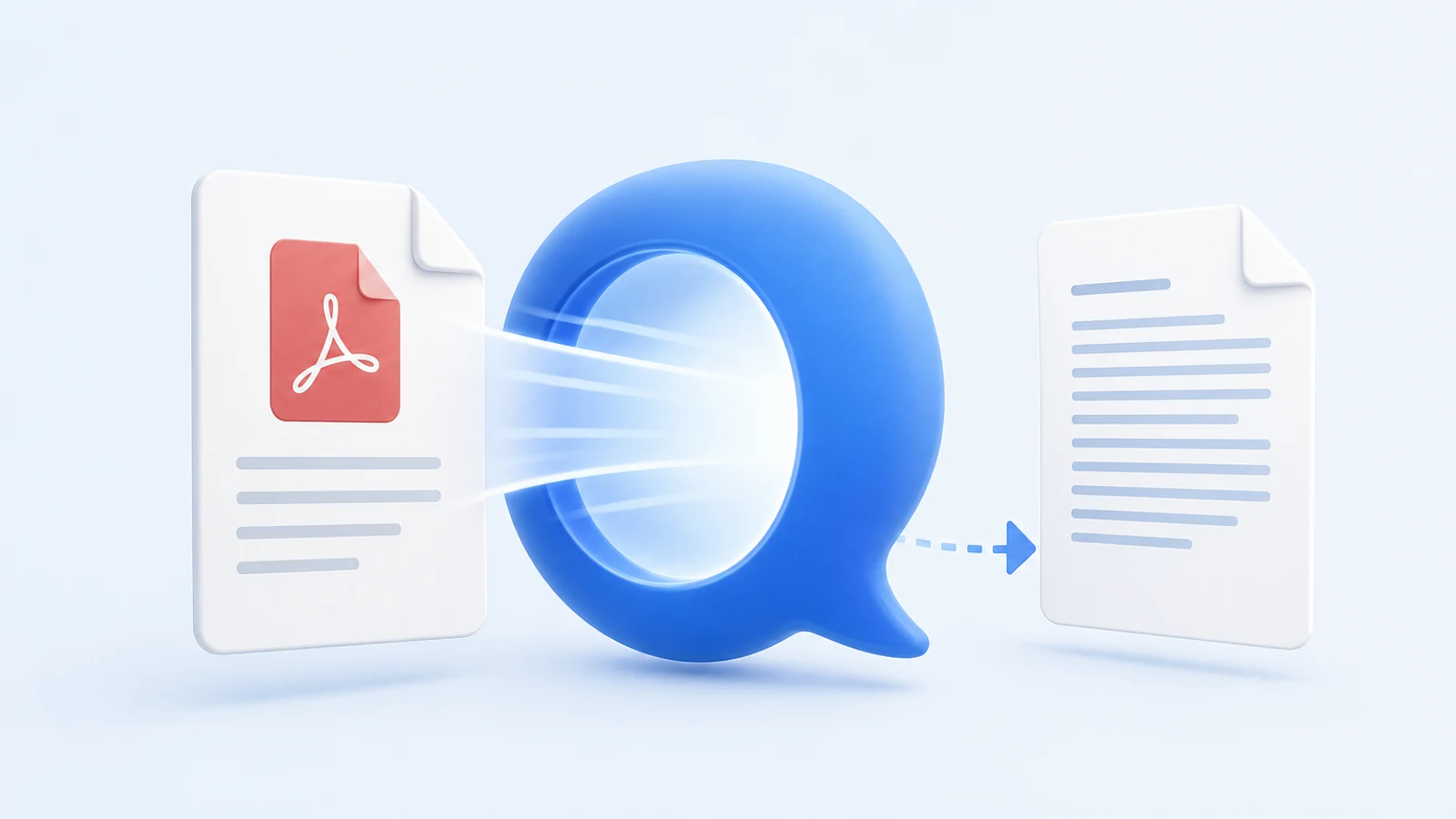
OpenAI's current supported-file documentation lists common document formats such as PDF and DOCX as inputs. That means ChatGPT can access document content in supported plans and contexts; it does not mean every uploaded file will be returned with the original layout, images, tables, page structure, or complete translation intact.
Where ChatGPT Works Well
Short messages and passages
ChatGPT can translate an email, paragraph, product description, or excerpt and adapt the tone for a defined reader.
Good prompt:
Translate this message from English to Japanese for a long-term business client.
Keep the tone warm and professional. Preserve all dates, names, and amounts.
Return only the translation.
The audience and constraints matter more than asking for a “high-quality translation.”
Comparing translation alternatives
Ask for two or three options when a phrase has a real tradeoff:
Give three Spanish translations of this headline:
1. literal,
2. natural editorial style,
3. concise marketing style.
Explain the tradeoff after each option.
This is useful during review because the model makes the decision visible. A qualified speaker still needs to choose the version that fits the context.
Terminology and glossary work
ChatGPT can extract recurring terms, propose translations, identify inconsistencies, and apply an approved glossary to a sample.
Use it to prepare decisions, not to approve itself:
- Extract candidate terms from the source.
- Have a qualified person approve names and terminology.
- Supply the approved glossary during translation.
- Check the output for exact adherence.
Translation review
ChatGPT can compare a source and target passage against explicit criteria:
- omissions;
- additions;
- changed numbers or names;
- terminology inconsistency;
- tone mismatch; and
- unnatural target-language phrasing.
Treat the findings as review candidates. An LLM can miss errors, invent issues, or prefer its own style.
Where ChatGPT Is the Wrong Main Tool
Complete books and long documents
A long context window does not guarantee a complete translation. Manual chapter-by-chapter chat creates operational risks:
- inconsistent prompts between sessions;
- missing or duplicated sections;
- names drifting across chapters;
- truncation near output limits;
- difficult completeness reconciliation; and
- manual file reconstruction.
For a full EPUB, PDF, or DOCX, use a workflow that tracks the complete file, segmentation, glossary, output, and retries. BookTranslator is designed around that file-level job.
PDFs where layout matters
ChatGPT can work with PDF content, but a PDF is a fixed-layout document. Reading the text and rebuilding the page are separate problems.
OpenAI explains that file handling varies by plan and document type; outside visual PDF retrieval contexts, document processing may rely on extracted text rather than every embedded image. Check the current OpenAI File Uploads FAQ before relying on a specific behavior.
Use the PDF formatting workflow when columns, tables, figures, captions, reading order, or page output matter.
Scanned or image-only files
A scan needs OCR before translation. Even when a multimodal interface can inspect pages, the project still needs:
- complete text recovery;
- correct reading order;
- confidence checks for names and numbers;
- translation;
- and a reconstructed output file.
For image-heavy PDFs, use the scanned PDF translation workflow.
Subtitle files with timing constraints
Translating cue text is only part of subtitle work. IDs, timestamps, line breaks, reading speed, speaker labels, and encoding also matter. Use a file-aware SRT translator or a subtitle editor rather than pasting cue text without validation.
High-stakes final output
Do not use an unchecked ChatGPT translation as the final authority for legal, medical, certified, safety-critical, or publication-sensitive content. The appropriate reviewer and accepted process depend on the receiving organization and jurisdiction.
A Reliable Prompt Pattern
Use four blocks:
TASK
Translate from [source language] to [target language].

AUDIENCE AND PURPOSE
[Who will read it and what they need to do.]

CONSTRAINTS
- Preserve names, numbers, dates, citations, and paragraph boundaries.
- Apply the glossary exactly.
- Do not summarize or add explanations.
- Return only the translation.

SOURCE
[Text]
For review, separate translation from critique. Generate the translation first, save it, then start a new evaluation pass with the source, target, and a rubric.
Four Practical Scenarios
| Scenario | ChatGPT fit | Better workflow when needed |
|---|---|---|
| Translate a short customer email and adjust politeness | Strong | Human approval for sensitive relationships |
| Compare two translations of a difficult paragraph | Strong | Qualified bilingual editor makes the final choice |
| Translate a 300-page EPUB with stable names and navigation | Weak as a manual workflow | EPUB Translator |
| Translate a scanned, two-column PDF and return a readable PDF | Weak as the only tool | PDF Translator with OCR workflow |
The dividing line is not text length alone. It is whether failure can be detected and repaired without rebuilding the entire project.
ChatGPT vs. Dedicated Translation Tools
| Capability | ChatGPT | Complete-file translation workflow |
|---|---|---|
| Short text translation | Strong | Usually supported but unnecessary |
| Tone alternatives and explanation | Strong | Often not the main purpose |
| Complete-file tracking | Manual and difficult at scale | Built into the workflow |
| Glossary across long content | Possible with careful setup | Designed to apply consistently |
| EPUB navigation | Not a normal chat output | File pipeline can preserve and validate it |
| PDF reconstruction | Not guaranteed by text access | Dedicated PDF workflow |
| OCR and reading order | Depends on interface and plan | Explicit scanned-file workflow |
| Downloadable translated file | Not guaranteed in the original format | Core output |
If the source is a short passage, use the simplest tool. If the source is a book or document whose structure matters, the document pipeline is part of translation quality.
How to Check a ChatGPT Translation
- Confirm every source paragraph has a target paragraph.
- Compare names, numbers, dates, units, citations, and negation.
- Search for untranslated fragments.
- Check glossary terms across the whole sample.
- Ask a qualified target-language reader to review meaning and naturalness.
- Save the exact model, prompt, date, and raw output.
- Test one difficult passage before scaling.
For model comparison, use the evidence-led best LLM for translation guide. For complete book workflows, compare the best book translation tools. For formatted PDFs, start with the document rather than the prompt: translate a PDF while keeping its format.
Dihlooho tse amanang