PDF Page Numbers Don’t Match the Book? Check Page Labels First
Fix PDF navigation that disagrees with printed pages. See six sample files covering Roman front matter, an inserted plate, and an excerpt starting at page 37.
If a PDF reader says page 4 while the book page itself says 1, first check the file's page labels. A cover and Roman-numbered introduction can shift the physical position without making the book incomplete. Correct navigation labels on a copy; do not start by stamping new numbers over the pages or deleting the introduction.
That repair has a limit: labels cannot restore a missing scan, fix the order of pages, or tell you what an illegible number used to be. First establish which page is actually present. Then make navigation describe it accurately.
We created three downloadable before/after pairs to demonstrate the distinction: a seven-page notebook, a version with an unnumbered illustration inserted, and an excerpt beginning at printed page 37. In every pair, the labels changed while the rendered pages stayed pixel-identical.
Separate the three numbers before fixing anything
For this guide, file position means the first, second, third page in the PDF. Printed number means the number visible on the page. Page label means the logical identifier stored for navigation, such as ii or A-1.
Those values can legitimately differ. PDF Association's page-label explanation describes numbering sequences, prefixes and the distinction between page indexes, numbers and labels. A file can contain Roman front matter, restarted body numbering and prefixed appendices without having an incorrect page count.
Here is the mapping in our seven-page teaching file:
| File position | Visible printed number | Original navigation label | Corrected label |
|---|---|---|---|
| 1 | None: cover | 1 | Cover |
| 2 | i | 2 | i |
| 3 | ii | 3 | ii |
| 4 | 1 | 4 | 1 |
| 5 | 2 | 5 | 2 |
| 6 | A-1 | 6 | A-1 |
| 7 | A-2 | 7 | A-2 |
Cover is a descriptive label we assigned, not a numeral printed on the cover. The total remains seven pages. A reader may show both a label and a position, such as 1 (4 of 7); seeing both is not a contradiction.
Download the seven-page file before labeling and the labeled version. Open the first body page in each and compare the page itself with the navigation controls.
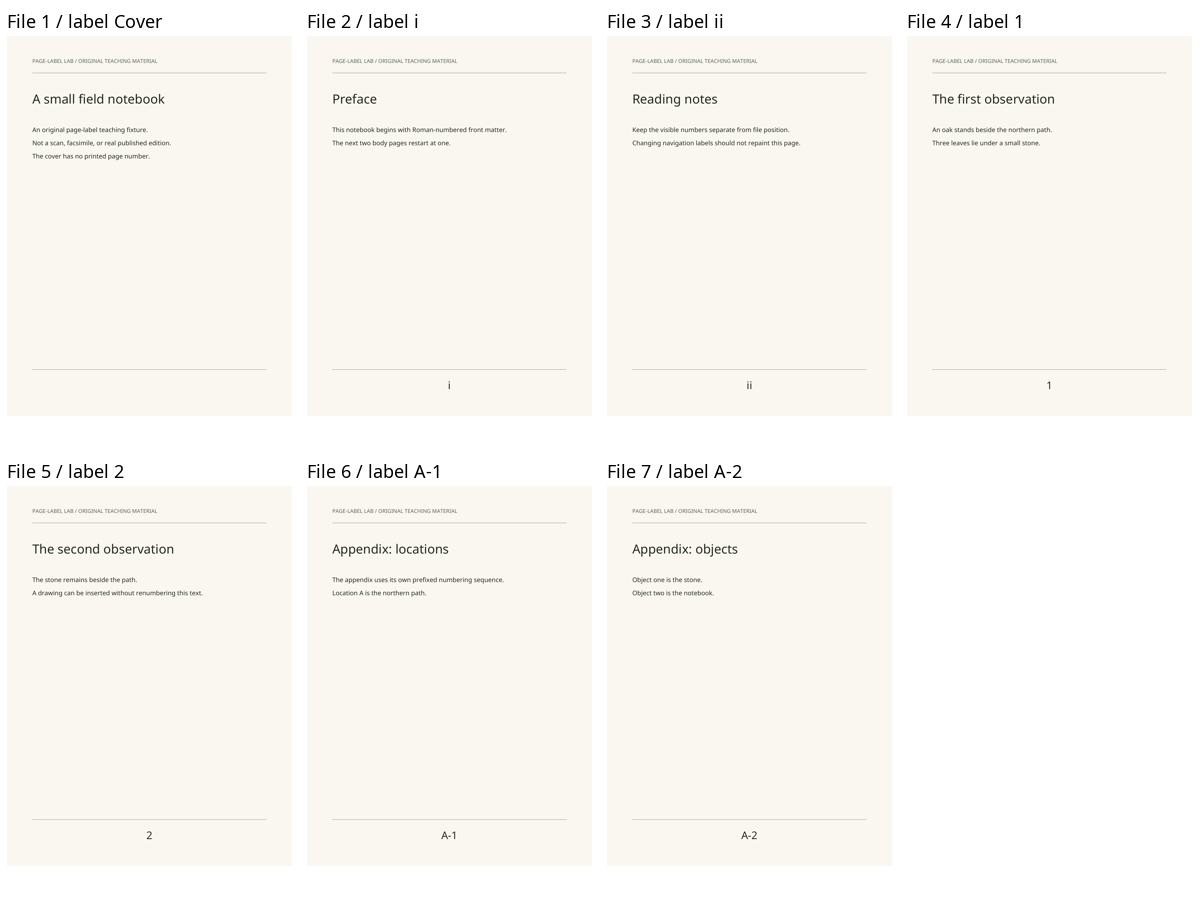
This is a preview of our authored pages with labels added outside the images, not a screenshot of a particular PDF application.
Map the section boundaries on a working copy
Before editing, save an unchanged original and identify the transitions by looking at the pages: the first numbered introductory page, the first body page, any inserts, and each appendix or numbering restart. Record the file position beside the visible identifier.
Check more than the first body page. In the example above, “add three” finds body page 1, but it does not describe the Roman introduction or the A- appendix. A single offset is a temporary shortcut within a continuous section, not a reliable description of the whole book.
If a sequence jumps unexpectedly—say the visible pages go from 38 to 40—inspect the intervening images and, if available, compare the same edition at the source. It may be a missing scan, an intentional insert, unusual original numbering, or a different ordering problem. Do not assign “39” to an unrelated page just to make the counter look continuous.
For signed or restricted PDFs, use the permitted source workflow or ask the document provider for a corrected reading copy. This article's fixture scripts are not a way to preserve or bypass those protections.
Change navigation labels, not the printed content
A desktop route documented by Adobe
Adobe's current Acrobat page-label instructions point to All tools → Organize pages → Page labels. Select a range, start a new sequence, then choose its numbering style, starting value and optional prefix. Repeat for separate sections; a continuous section can extend the preceding sequence.
For our example, that means Roman numbering for the introduction, decimal numbering restarted at 1 for the body, and decimal numbering with A- for the appendix. Confirm the actual selected pages before applying each change, especially when existing labels already differ from file positions.
Adobe distinguishes these navigation labels from visible header/footer numbers. If you only want the reader's page controls to match the book, adding a visible footer is a different operation.
These steps are documentation-based. We did not run an Acrobat repair or test a particular Acrobat interface for this article.
The method we actually tested with pypdf
Our fixtures were created with ReportLab, cloned with pypdf 6.10.0, and assigned labels without changing their page content streams. For the seven-page sample only, the core operation is:
from pypdf import PdfReader, PdfWriter
from pypdf.constants import PageLabelStyle

reader = PdfReader("seven-page-before.pdf")
writer = PdfWriter(clone_from=reader)
writer.set_page_label(0, 0, prefix="Cover")
writer.set_page_label(1, 2, style=PageLabelStyle.LOWERCASE_ROMAN, start=1)
writer.set_page_label(3, 4, style=PageLabelStyle.DECIMAL, start=1)
writer.set_page_label(5, 6, style=PageLabelStyle.DECIMAL, prefix="A-", start=1)

with open("seven-page-labeled-copy.pdf", "xb") as output:
    writer.write(output)

assert PdfReader("seven-page-labeled-copy.pdf").page_labels == [
    "Cover", "i", "ii", "1", "2", "A-1", "A-2"
]
The API uses zero-based indexes: file position 4 is index 3. The ranges above include both endpoints. The exclusive output mode, xb, refuses to overwrite an existing file. See the versioned pypdf page-label API and our complete generator for the exact implementation.
Do not paste those ranges into an unrelated book. Establish its section map first. Our tested script accepts no customer or source PDF: it generates only the original examples defined inside it.
Two cases where a fixed offset fails
An unnumbered illustration changes the body offset
In the second fixture, we inserted a plate between printed body pages 1 and 2. The plate has no printed numeral. We assigned it the descriptive label Plate-A and resumed the next body page at 2.
| File position | Visible page identifier | Label |
|---|---|---|
| 4 | 1 | 1 |
| 5 | Unnumbered illustration | Plate-A |
| 6 | 2 | 2 |
Before the insert, printed page 1 was at file position 4: an offset of three. After the insert, printed page 2 is at file position 6: an offset of four. Reusing the first offset would send you to the illustration.
Compare the eight-page version before labeling with the labeled version. The repair adds a label section at the insert and restarts the body sequence after it. It does not turn the plate into a numbered source page or remove it from the file.
An excerpt can begin at printed page 37
Our third fixture contains three pages visibly numbered 37, 38 and 39. Their file positions are 1, 2 and 3. Appropriate labels begin at 37, not 1.
The before file and after file both contain exactly those three pages. Labeling the first page 37 does not imply that the PDF contains the preceding 36 pages.
For a real excerpt, use numbers you can verify on the source. If the first visible number is missing or cropped, obtain supporting source evidence before assigning it. A convenient guessed sequence can be more misleading than a plain file-position count.
Verify the saved file, not just the editing dialog
For these three pairs, we reopened all six PDFs and checked every label. Poppler 26.08.0 rendered both versions at 144 dpi. All 18 corresponding page pairs had identical pixels, and all 18 page content streams matched byte-for-byte. Nothing was stamped onto or removed from the page content in this test.
The per-page results include file hashes, labels and pixel comparisons. The downloadable page map records file positions, zero-based indexes and visible numbers. Reproduction instructions explain the dependency versions and how to regenerate the examples in new directories.
That verifies our files, not every viewer's handling of them. PDF Association documents differences in label support between applications; its published viewer survey is from 2024, not a test we repeated today. Check the reader you will actually use:
- Reopen the saved copy and confirm the total page count is unchanged.
- Inspect the first and last page of each numbering section.
- Try navigating to
ii,1andA-1, or the equivalents in your document. - Confirm that each jump lands on the intended visible page—not merely on a matching-looking counter.
- If the reader ignores the labels, retain the explicit position-to-page map or use a reader that handles them. Do not repeatedly rewrite correct labels to compensate for an unsupported interface.
A matching render does not prove accessibility, valid signatures, working links or correct extracted text. If the page looks right but copied text is wrong, use the separate PDF text-layer diagnosis. That issue is not repaired by page labels.
Keep the original map if you later translate the document
If accurate navigation was the only problem, stop here. OCR or translation is not needed to rename page labels.
If language is still the obstacle, retain the original file and page map before following the scanned-PDF translation workflow or the guide to PDF translation and formatting. For broader output checks, use the PDF translation QA checklist.
Readers choosing BookTranslator's PDF Translator should not assume that source page labels survive a rebuilt output. OCR Mode may change the original layout, fonts and font sizes. If the output reflows, confirm important passages against the original; copying the old numbering map onto new page breaks does not preserve correspondence.
The goal is not to make every number identical. It is to make each number unambiguous: where a page sits in this file, what the source calls it, and how your reader reaches it.
Verwandte Beiträge