Translation QA Checklist for Books and Long Documents
A practical acceptance checklist for complete translated books and documents, with defect severity, sampling rules, format-specific checks, and a downloadable issue log.

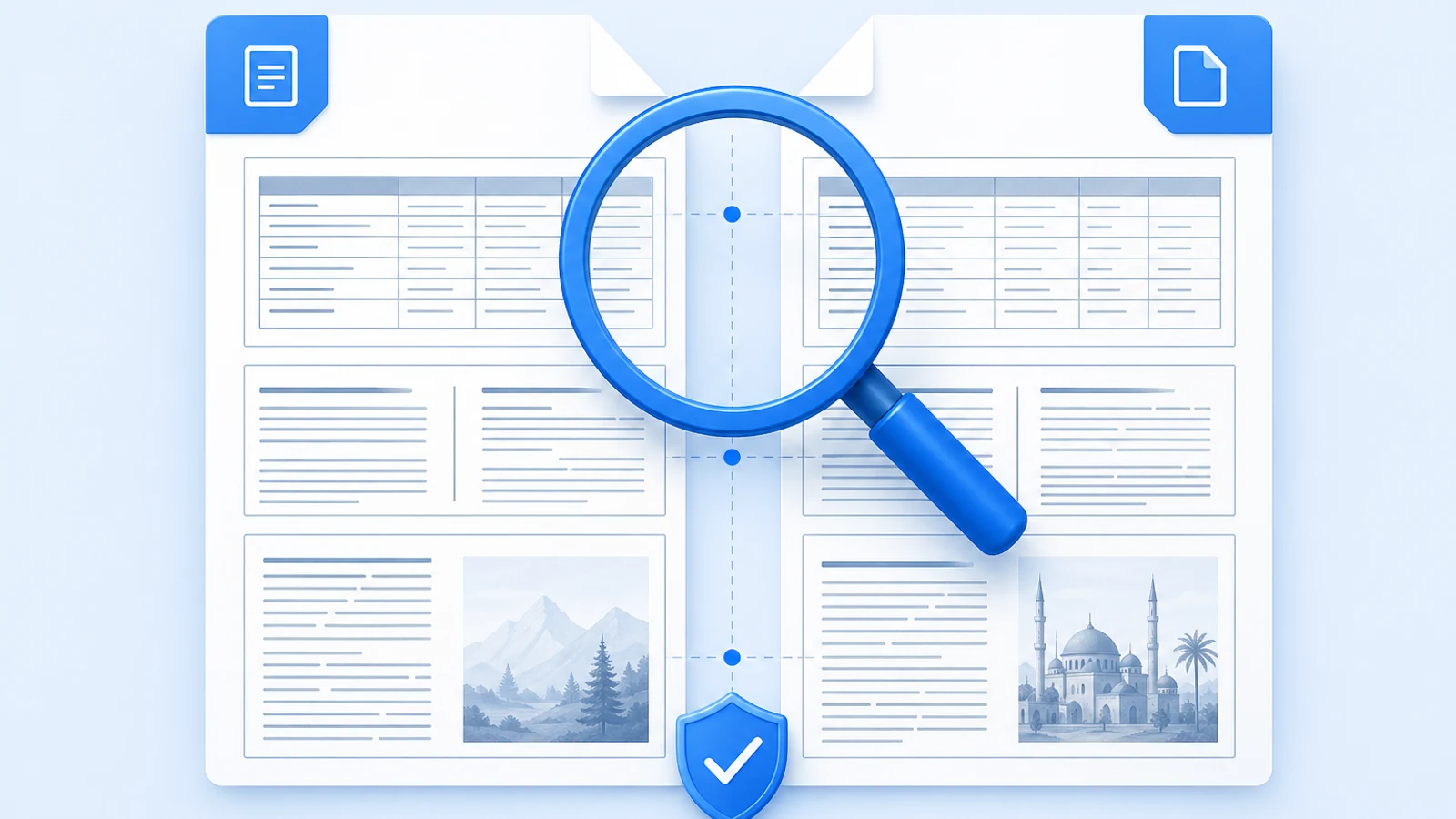
A translated book is ready only when the target file is complete, accurate enough for its intended use, structurally usable, and internally consistent. Fluent paragraphs are not sufficient evidence. Quality assurance has to compare the whole deliverable with the exact source version and produce an issue log someone can close.
Use this sequence:
- Freeze the source and define acceptance criteria.
- Run complete-file checks for missing, duplicated, or reordered content.
- Review meaning, names, terminology, numbers, citations, and untranslated text.
- Test the structure that matters for the output format.
- Sample difficult content deliberately, then expand the review when failures cluster.
- Classify every defect as blocker, major, or cosmetic.
- Recheck fixes before accepting the file.
Download the translation QA issue log template and adapt its acceptance column to your project before review begins.
Define "good enough" before you inspect the translation
The same translation can be acceptable for personal reading and unacceptable for publication. Write down the intended use first.
| Intended use | Minimum review expectation | Typical rejection trigger |
|---|---|---|
| Personal comprehension | Complete file, readable meaning, usable order | Missing chapters or meaning reversed in important passages |
| Internal research | Source traceability, accurate claims, numbers, citations, and terminology | A claim, table, citation, or named entity no longer matches the source |
| Client or team circulation | Agreed terminology, stable structure, issue log, reviewer sign-off | Recurring errors or unresolved major defects |
| Public release | Native-language editorial review, complete production QA, platform checks | Any blocker, systematic language problem, or broken reading experience |
| Legal, clinical, regulatory, or safety use | Qualified domain review and the required formal process | Unverified material claim, instruction, warning, dose, obligation, or limit |
This distinction prevents a common failure: a reviewer keeps polishing punctuation while nobody has confirmed that the final chapter exists.
The ISO 5060:2024 overview describes analytic evaluation using error types and penalty points and explicitly discusses sampling. This checklist uses the same useful idea—define categories and severity—but it is an operational acceptance workflow, not a claim of ISO conformity.
Use three defect levels that change the decision
A severity label is useful only when it tells the team what to do next. Do not calculate a decorative score that lets one catastrophic error disappear inside hundreds of correct sentences.
| Severity | Decision rule | Examples | Release action |
|---|---|---|---|
| Blocker | The file cannot safely or meaningfully be used for its intended job | Missing chapter; wrong source version; reversed warning; broken EPUB navigation; unreadable output; personal data exposed | Stop delivery, fix the cause, and rerun affected checks |
| Major | A reader can continue, but meaning, consistency, or a required structure is materially wrong | Repeated name drift; mistranslated technical term; incorrect number; collapsed table; lost footnotes; untranslated passages | Fix before acceptance and search for the same error pattern elsewhere |
| Cosmetic | Meaning and use are intact, but presentation or local style needs correction | Isolated spacing, punctuation, widow/orphan, or non-critical style inconsistency | Batch-fix when practical; accept only if the project allows it |
Severity depends on context. A changed decimal separator may be cosmetic in a fictional prop and a blocker in a dosage table. Record both the defect and why it matters.
Phase 1: confirm the source and the output belong together
Before reading prose, prove that you are reviewing the right files.
- Record the source filename, revision, language, and checksum or immutable storage link.
- Record the target language, output format, translation date, and workflow settings.
- Confirm that comments, tracked changes, hidden text, appendices, and back matter were intentionally included or excluded.
- Compare the table of contents, chapter count, section order, and first and last content blocks.
- Check page, slide, worksheet, subtitle-cue, or document-part counts when the format exposes them.
- Open the file in the application readers will actually use.
If the source changed during translation, stop. Mixing fixes from two source versions creates defects no language review can reliably repair.
Phase 2: look for completeness failures before style problems
Complete-file defects are cheap to detect and expensive to miss. Check for:
- missing or duplicated chapters, paragraphs, list items, table rows, captions, footnotes, endnotes, and appendices;
- source-language text that should have been translated;
- target text that was added without a source counterpart;
- headings detached from their sections;
- pages or sections in the wrong order;
- truncated opening or closing content; and
- repeated boilerplate that replaced real content.
The European Commission's current translation quality evaluation information pack distinguishes mistranslation, omission, addition, untranslated content, and terminology errors. Those categories are useful because each suggests a different search: compare source and target, scan for source-language leftovers, and search repeated terms across the entire output.
For a visual reference, the real translation samples show concrete PDF failure surfaces including reading order, tables, scripts, names, and missing content.
Phase 3: review meaning and controlled details
Reviewers should separate six questions instead of giving one vague "looks good" verdict.
Meaning
Compare claims, relationships, negation, modality, sequence, and tone against the source. Give priority to passages where a small word changes the instruction: must/may, before/after, increase/decrease, or included/excluded.
Names and terminology
Search every main character, organization, product, place, acronym, and domain term. Record the approved form and every rejected variant. A term that is acceptable in isolation can still be a major defect when it changes between chapters.
Numbers and structured references
Check dates, decimals, units, currencies, percentages, ranges, figure labels, table references, equation numbers, citations, URLs, part numbers, and warning codes. Do not assume non-translatable content is automatically preserved.
Fluency and register
Read connected passages, not only isolated sentences. Check whether dialogue sounds like the same characters, instructions maintain the same level of formality, and headings use a stable editorial style.
Locale conventions
Confirm punctuation, quotation marks, dates, units, names, addresses, alphabetical order, and right-to-left behavior for the intended market. Locale review is not a search-and-replace step.
Untranslated and forbidden-to-translate content
Search for source-language residues, but compare them with the do-not-translate list. An author name, code, trademark, formula, or cited title may need to remain unchanged.
Phase 4: test the output as its actual format
The acceptance surface changes by file type.
| Format | Highest-risk checks | Minimum device or application test |
|---|---|---|
| Reading order, text clipping, columns, tables, figures, fonts, links, selectable text | Desktop PDF reader plus one mobile-size view; copy a multi-column passage to inspect logical order | |
| EPUB | Navigation, chapter boundaries, reflow, language metadata, cover, notes, images, embedded fonts | At least two independent reading systems and multiple font sizes |
| DOCX | Styles, headings, tracked changes, comments, tables, headers/footers, fields, page breaks | Microsoft Word or the required editing environment, with markup visibility checked |
| SRT | Cue numbering, timestamps, line breaks, overlaps, reading speed, encoding | Subtitle editor plus playback against the source video |
For PDF-specific diagnosis, use the format-preserving PDF workflow. For EPUB tool and package risks, use the EPUB translation tools guide. For editable Word delivery, use the DOCX formatting workflow.
Sample risk, not convenience
Reading three random pages is weak QA because rare, difficult structures are precisely what random selection can miss. Build a forced-coverage sample.
At minimum, include:
- The title page, opening, and first chapter or section.
- The ending, conclusion, references, and back matter.
- Every distinct structure: table, figure, footnote, list, formula, dialogue block, code block, or subtitle sequence.
- A chapter boundary and one long continuous passage.
- Pages with the densest names, terminology, numbers, and citations.
- Right-to-left, non-Latin, or mixed-script content when present.
- Any content that would cause material harm if wrong.
Then use a simple escalation rule:
- One isolated cosmetic defect: log it and continue the planned sample.
- One major defect: search the full file for the same pattern and expand the adjacent sample.
- Two major defects of the same type: treat the issue as systematic until a wider review disproves it.
- Any blocker: stop acceptance, fix the cause, and rerun all checks the cause could affect.
This is a decision rule, not a statistical guarantee. High-risk delivery may require complete review by qualified people.
Use an issue log that makes fixes auditable
Each issue should contain enough evidence for another person to reproduce it.
| Field | Example |
|---|---|
| Location | Chapter 7, paragraph 12; source page 184 |
| Category | Terminology |
| Severity | Major |
| Source | "control surface" |
| Current target | Two different target terms across chapters 2 and 7 |
| Expected | Approved glossary form |
| Evidence | Search results show 14 + 3 occurrences |
| Owner | Language reviewer |
| Status | Fixed, awaiting verification |
Use the downloadable CSV issue log as a starting point. Keep one row per defect pattern when a global fix is possible, but list every affected location or attach search output. After the change, a second person or a fresh pass should verify the correction in the final file—not in an intermediate export.
Final release gate
Accept the translated deliverable only when all of these statements are true:
- The source version and target deliverable are unambiguous.
- The opening, ending, chapters, sections, and required assets are complete.
- No blocker remains open.
- Major defects are fixed and the same patterns were searched across the full file.
- Names, terms, numbers, citations, and do-not-translate items passed their checks.
- The actual output format works in the required readers or applications.
- The final export, not an earlier draft, received the verification pass.
- The issue log, glossary, source, output, and acceptance decision are stored together.
If you are producing a first translated draft, BookTranslator can process complete books and long documents instead of requiring copy-and-paste. For eligible non-PDF tasks, its current translation form also offers an Auto glossary option for recurring names, places, and specialized terms. That can reduce drift, but it does not replace the source comparison, format checks, or risk-appropriate human review in this checklist.